
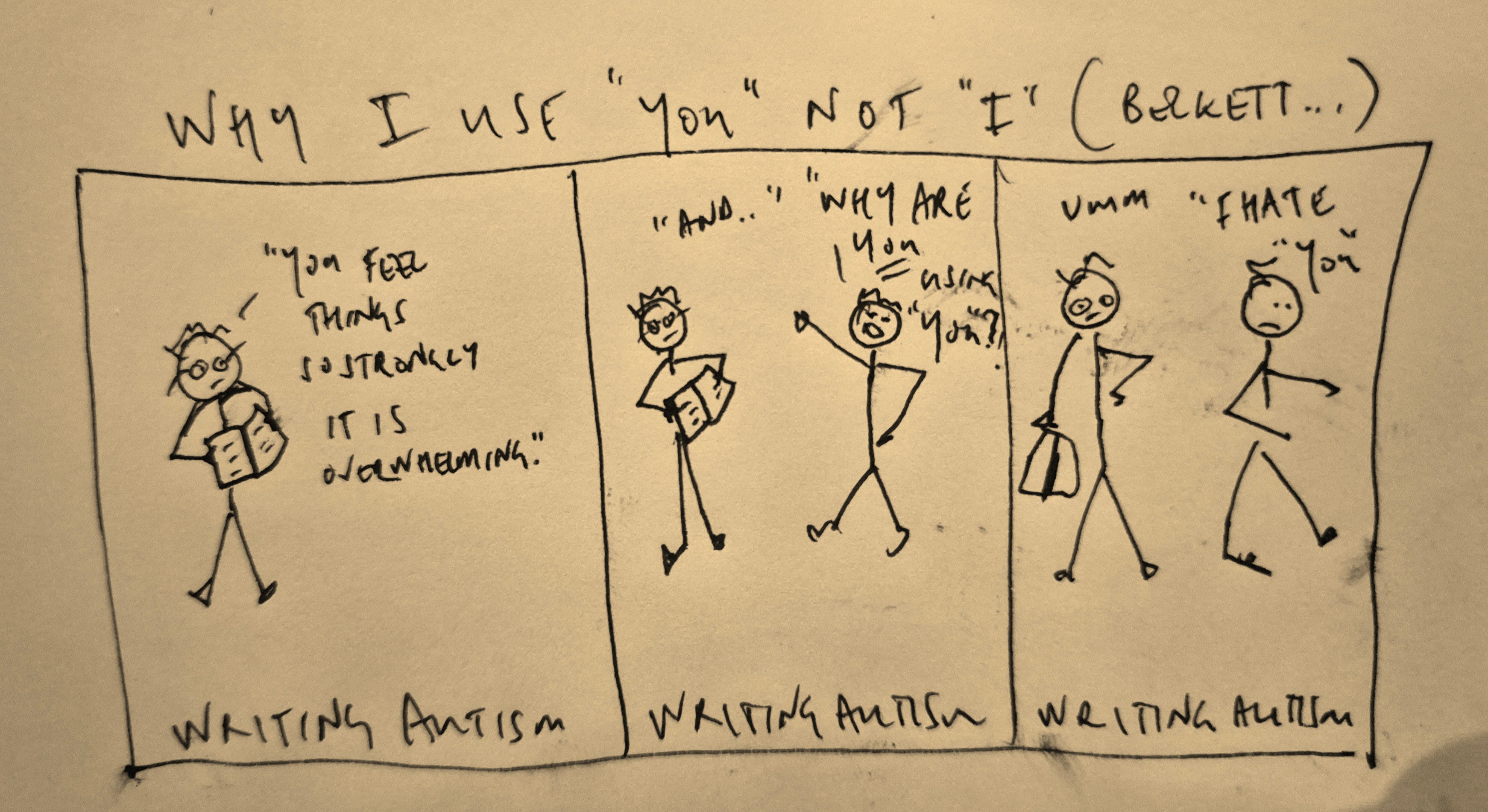
Lots of people — quite rightly — have asked why I use the pronoun “you” not “I” in my forthcoming book with Revol Press (2027) Writing Autism: A Critique of Life, Language and Neurodivergent Cultures. Ever willing to people please, I thought I would summarise this choice here.
1. I use the “you” pronoun instead of “I” in Writing Autism to critique neuro-normative storytelling conventions.
My use of “you” is designed to draw attention to the restrictive conventions of memoir writing. In such books, the “I” signifies an illusory individual subject distanced from material and historical conditions. As I write in my book:
“To refer to Mike Watson’s work, your writing practices resist the false assumption that the only route to “ontological security” is via “unimpeded expression” of individuality and notions of authenticity. To resist the complicities and capitulations to alienation inherent in un-critiqued language usage, you alienate your language to draw attention to alienations inherent in capitalist and competitive individualist expression.”
I’m a Marxist and a dialectical materialist. These practical and intellectual profiles mean that I see interconnections between everything, including ways in which language operates to alienate us all. In other words, I use “you” to draw attention to the ways in which the individualised, neoliberal subject is commodified to give the impression of atomised subjectivity without conditions, history and corporeal and collective struggle.
2. I use “you” as a challenge to narrative “masking”.
My use of “you” also draws attention to the ways in which my use of “I” might be a form of masking. I outline in my book how this “I” has be hijacked by an internalised version of what I thought I should be (the ableised “I”, we might say). This “I” is, in part, also created by the externalised fixity of others’ sense of their version of “him”. I challenge social and cultural representation of “his” autism.
Hence “you” is a linguistic register of my queering of language, or at least not wanting to capitulate to the petrifaction of self in grammatical terms which always-already assume fixed and transcendental categories to those pronouns. “I” and “he” are not fixed; they are materially, historically located and change in relation to the conditions in which they operate.
3. A move to put a reader in an autistic person’s experiencing body and mind.
“You” also uncannily enjoins a reader to experience the narrator’s perspectives, (reversing, perhaps, the “double empathy” power dynamics, which places disabled people as “lesser than”).
4. It’s fun to mess with neuro-normative linguistic expectations
Besides all which, my use of “you” is fun and will probably piss the right people off, specifically those who do not like the ways in which my use of the “you” promotes critical reflection on the reification of exceptionalised “I” narratives, particularly by and about autistic people.
My choice of the “you” pronoun, finally, is an inbuilt device of queering language to fuck with neuro-normative expectations of what a book like this will look like. As I say in my book: I have chosen “Autie Form for Autie Content.” And I’m sure the right people will get it.
I will finish by quoting from the introduction to my own book, shifting — as the book does — into the pronominal “you”:
“You suppose that you are engaged, here, with a critical relationship with the expressive “you”. To your knowledge, you do not think that the consistent pronominal use of “you” in creative writing has been theorised extensively, if at all. There are, however, distinguished writings in this mode, most notably Jane Rule’s novel This is not for You and Christine Brooke-Rose’s exemplary and exceptional writing, particularly her own superlative non-memoirs, Remake (1996) and Life, End of (2006). The writer whose work you have devoured the most, Anthony Burgess, called the second installment of his autobiography, You’ve Had Your Time. Perhaps the ironic deprecation of this title is an unconscious motivator behind your choice of pronoun, as reference your descriptions of your sense of morose moribundity throughout this book. The second person perspective might take a little getting used to (have you, reader, got used to it yet?); you (reader) might feel that the narrator (“he”) is constantly spanking you with interpellating imperatives: you do this; you do that; you always were like this; you always are like this. You’re beyond redemption, you weirdo!”
See Mike Watson, Hungry Ghosts in the Machine: Addiction, Digital Capitalism and the Search for Self (Revol Press, 2024), 66